| .. |
VACCINES POSSIBLY AT RISK
In December 2000, the FDA reported several firms might have used
beef protein broths and calf serum from Europe to make vaccines.
In America, these vaccines are in question:
Diptheria, tetanus and acellular pertussis vaccine by North American Vaccine
Hepatitis A vaccine by SmithKline Beecham15
In Canada, these five vaccines are in question:
Act Hib (prevents hemophilus influenzae Type B) by Aventis Pasteur
Infanrix (prevents diptheria, tetanus and acelluar pertussis in young children) by SmithKline Beecham
Havrix (a hepatitis vaccine) by SmithKline Beecham
IPOL (inactivated polio virus) by Aventis Pasteur, sold in Canada
under the name Imovax Polio
Pnu-Immune (pneumococcal polysaccharide) by Wyeth Ayerst16
Officials say there is only "minimal risk" for contracting any
disease from these vaccines. These firms have been directed to
"be more rigorous in the manufacturing processes" by the end of
2001.17 That gives us another full year of potentially risky vaccines
besides what is already in stock.
From the CDC: "Animal-derived products used in vaccine manufacture
can include amino acids, glycerol, detergents, gelatin, enzymes
and blood. Cow milk is a source of amino acids, and sugars such
as galactose. Cow tallow derivatives used in vaccine manufacture
include glycerol. Gelatin and some amino acids come from cow bones.
Cow skeletal muscle is used to prepare certain complex media.
Many difficult to grow microorganisms require the addition of
serum from blood to the growth media."18
DIETARY SUPPLEMENTS
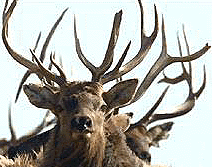 How much is a beautiful, energetic body worth? If it's healthy - everything. If it's contracted nvCJD in the process, it's worth less than the Swiss cheese their brain resembles. Asians take velvet, a soft and highly vascular hairy skin that nourishes deer antlers during rapid growth, and use it as an aphrodisiac. Last month Koreans impounded 12 tons, about $900,000 worth of elk velvet, after discovering Saskatchewan farms had experienced a chronic wasting disease outbreak last year. Even though all 1,500 of the domestic elk were destroyed, burned and buried, the Korean ban against Canadian velvet remains intact. How much is a beautiful, energetic body worth? If it's healthy - everything. If it's contracted nvCJD in the process, it's worth less than the Swiss cheese their brain resembles. Asians take velvet, a soft and highly vascular hairy skin that nourishes deer antlers during rapid growth, and use it as an aphrodisiac. Last month Koreans impounded 12 tons, about $900,000 worth of elk velvet, after discovering Saskatchewan farms had experienced a chronic wasting disease outbreak last year. Even though all 1,500 of the domestic elk were destroyed, burned and buried, the Korean ban against Canadian velvet remains intact.
Most citizens just assume their government is watching out for
their welfare. People take supplements and we believe they are safe, but what happens if they slip up? Before you pop that pill or powder, did you check its source? Especially when products are ordered off the Internet, it's easy to make the purchase without fully checking ingredients. It may be too much of a bother to email the supplier and check out all the ingredients first. Once you get the product, don't you start taking it right away
thinking it's OK?
Nutritional supplements using bovine glands such as pituitaries,
prostates or kidneys may also include an unwanted ingredient -
Mad Cow. These supplements contain hormones which supposedly help
organs perform better, boost immune systems or make us feel more
energetic, but they may have deadly consequences.
Although the FDA says European bovine products should not be imported into this country because of an import alert
ban put into effect within the past two years, BSE-infected material
may have come in prior to the ban. Should not? Where's the force and meaning behind "should not"?
To prevent nutritional supplement makers from using materials
from infected cows, the FDA in November wrote a letter to the
industry to "take all steps to assure the public that such ingredients
do not come from cattle born, raised or slaughtered in countries
where BSE exists."19
Some experts believe this industry has not been monitored enough
by the FDA and may pose risks to the public. Dr. Peter Lurie is
director of the Public Citizen Health Research Group and a member
of the FDA advisory committee on Mad Cow. He states, "There is
no way of being certain that some dietary supplement ingredients
do not come from British cows."20
Michael Hansen, research associate at the Consumer Policy Institute,
the research unit of Consumers Union, concurs. He says Americans
should avoid taking any glandular supplements, even if they are
made from cows in the US, reminding us it takes five years for
BSE to incubate. He also advises people to keep asking pointed
questions until you get specific, satisfying answers as to where
glandular products come from.
This is not a time for reticence and shyness. It doesn't matter
if the vendor gets annoyed by probing questions. This is your
health, your life at stake. If the seller can not give you an
unvarnished, satisfactory, unhesitating and complete answer, go
to a different shop. If they ask you why, be straight about your
concerns regarding BSE. It will be doing you, them and the public
a favor showing you will not purchase or consume products in question
and will force the vendors to become more discriminatory.
The FDA may consider regulating these glandular products more
rigorously or removing them from the shelves altogether.
BUYER BEWARE
Various products from cattle used in vaccines and foods may be found hazardous. As the evidence grows, there is enough concern about blood transmission that many bans are in place for whom can donate from Europe. Tallow, gelatin and milk are also still being used in vaccines,food, cosmetic or household items even though NONE of these items havebeen given an unequivocal all-clear.
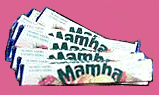 Wednesday of this week, candy made in Werther, Germany from beef-based gelatin was pulled from stores in Poland. The product, Mamba fruit chew, is sold in all five boroughs of New York where health officials are investigating it. When the US headquarters for Storck company in Chicago was contacted, they declined to comment other than to say their candy was safe. The article did not specify where else in America this fruit candy is sold, nor the other 78 countries besides the US and Poland which sells the product. Mamba has agreed to remove the beef gelatin from the Polish product, but not from the same candy sold in the US. If the ingredients can be changed for Poland, why not for everyone? Even if gelatin IS found to be a danger, but removed from this candy, it's still found in many, many products.21 Wednesday of this week, candy made in Werther, Germany from beef-based gelatin was pulled from stores in Poland. The product, Mamba fruit chew, is sold in all five boroughs of New York where health officials are investigating it. When the US headquarters for Storck company in Chicago was contacted, they declined to comment other than to say their candy was safe. The article did not specify where else in America this fruit candy is sold, nor the other 78 countries besides the US and Poland which sells the product. Mamba has agreed to remove the beef gelatin from the Polish product, but not from the same candy sold in the US. If the ingredients can be changed for Poland, why not for everyone? Even if gelatin IS found to be a danger, but removed from this candy, it's still found in many, many products.21
4-LEGGED KIDS

"Please don't feed us prions." - Seismo and Taco Deyo
The LAST thing we'd ever want to do is feed these guys prions. Look at these trusting faces. . .They can't choose their own food so it's up to their parents to help them out.
There are rightful concerns about feeding "meat and meat by-products"
as well as "chicken and chicken by-products" to pets.
THE DOGS SAID, "NO THANK YOU!"
In the US alone, the pet food industry is an $11 billion dollar
business annually -- $25 billion worldwide. We'd like to think
for those dollars, 4-leggeds were getting a great steak or grilled
breast of turkey. Many pet food companies are owned by multinational
corporations and use a pet food business as dumping grounds for
their waste products.
Three of the five major pet food companies in the US are subsidiaries
of major multinational companies:
Nestle - Alpo, Fancy Feast, Friskies, Mighty Dog
Heinz - 9 Lives, Amore, Gravy Train, Kibbles n Bits, Recipe, Vets
Colgate-Palmolive - Hill's Science Diet Pet Food
Procter & Gamble - Eukanuba and Iams
Mars - Kal Kan, Mealtime, Pedigree, Sheba and Nutro22
What's in most pet food is pretty disgusting. Some are bacteria-contaminated
and inedible by humans. If you really want to know what's in your
pet's food, read this article from the Animal Protection Institute. Afterwards, you may choose
to make your own pet food. They provide some good sample recipes on their web site.
Like human food, the ingredients are listed in order of percentage
of content. For example, whatever is listed first, is the ingredient
in highest concentration.
When I opened a can of very well known high end, name-brand canned
dog food, in it was something smooth, tubular and about 1/2 inch
across. As I sunk in the spoon, a delightful odor assaulted the
nostrils and the flabby object waved obscenely on the spoon. Stan
said it was probably a vein. Ugh! It looked very unappetizing
and the dogs left it in their bowl untouched. Now that's saying
something considering Seismo has wolfed down (and thrown back
up) more than his share of mice. (Doesn't everyone eat their trophies?)
WHAT ARE THEY EATING?
Here are some other choice tidbits in pet food.
Chicken Byproduct Meal
consists of rendered, clean parts of the carcass of slaughtered
chickens including necks, feet, undeveloped eggs, and intestines
excluding feathers except those unavoidably included. All water
is removed, then it's ground to a meal consistency.
Chicken Byproducts
includes everything above without removing the water or grinding
it up.
Chicken Meal
is dry rendered clean chicken flesh and skin (with or without
bones) excluding feathers, heads, feet, or entrails. This ingredient
is digestible, palatable, and more expensive than the first two.
It is considered to be the single best source of protein in commercial
pet foods.
Poultry Protein
is the clean combination of flesh and skin (with or without bone)
from carcasses of turkeys, ducks, geese, buzzards, etc. excluding
of feathers, heads, feet, and entrails.
Beef Byproducts
are non-rendered, clean parts, other than meat, from slaughtered cows including but not limited to lungs, spleen,
kidneys, brain, livers, blood, bone, partially defatted low temperature
fatty tissue, stomachs and intestines and their contents. It does not include hair, horns, teeth and hoofs. Boy, are we
glad to know Seismo and Taco aren't eating hair, horns or hoofs
when they can dine on feces! Now that's a nutritional break!
Beef
is the clean flesh of slaughtered cattle limited to striated skeletal
muscle or from the tongue, diaphragm, heart or esophagus. It includes
the accompanying and overlying fat and any skin, sinew, nerve,
blood vessels and all parts of the cow not eaten by humans. Beef
is a common allergen for many dogs and the cause of skin irritations.
Animal Digest
is MRM (mechanically removed meat) which is pressured off with
water and turned into broth. MRM is oftentimes removed from the
vertebrae, terribly close to the spinal cord which is a big carrier
of prions. Animal digest is made from "unspecified parts of unspecified
animals". (Mystery meat for pets.) Any kind of animal can be included:
goats, pigs, horses, rats, etc. and obtained from any source so
there's no quality control. It does exclude hair, horns, teeth,
hooves and feathers except in trace amounts. Labeling must reflect
ingredients. "Beef flavor" must come from cows. If it reads "pork
flavored", it has to be from pigs. In other words, they can't
fake the flavoring. Hmmm. . . ever seen anything labeled "rat
flavored?"23
In view of BSE and the deadly effects of feeding animals MBM -
meat and bonemeal, it looks like the safest products contain Chicken
Meal and Poultry Protein. Of beef products, the ingredient labeled
"Beef" seems the least offensive, but one has to question how
nutritious are sinew, nerve and blood vessels. Good thing our
4-legged kids prefer chicken. The Animal Protection Institute
has the best general and unbiased information on selecting commercial pet food we've seen.
CATS, DOGS, SCRAPIE AND BSE
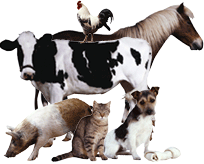 "BSE is particularly important within the pet industry since ingredients such as sheep with scrapie and cattle with Downer's Disease may be used in pet foods. The U.S. production of sheep family by-product meal was estimated in 1995 to be 4,500 pounds per working day or just enough to produce five tons of "lamb" and rice dog food daily. Since dogs have not been found to have any form of BSE, the relegation of that by-product meal entirely to dog foods can be considered relatively safe if pet-food plant sanitation is adequate to prevent contamination into cat foods. If the remainder of the "lamb by-product meal" and lamb (meat) is obtained from countries which have only scrapie-free sheep, then that lamb can be used in cat foods with relative safety. For each pet producer's integrity, it is almost obligatory to obtain a guarantee by the supplier that each shipment of lamb or lamb by-product meal used in cat foods is supplied entirely from those countries free of sheep and goat scrapie. Some American companies have followed that safety practice. For example, IAMS, and perhaps other companies, own sheep slaughter facilities in New Zealand and Australia supplying their entire "lamb" needs thus insuring their ingredients are from scrapie-free sources."24 "BSE is particularly important within the pet industry since ingredients such as sheep with scrapie and cattle with Downer's Disease may be used in pet foods. The U.S. production of sheep family by-product meal was estimated in 1995 to be 4,500 pounds per working day or just enough to produce five tons of "lamb" and rice dog food daily. Since dogs have not been found to have any form of BSE, the relegation of that by-product meal entirely to dog foods can be considered relatively safe if pet-food plant sanitation is adequate to prevent contamination into cat foods. If the remainder of the "lamb by-product meal" and lamb (meat) is obtained from countries which have only scrapie-free sheep, then that lamb can be used in cat foods with relative safety. For each pet producer's integrity, it is almost obligatory to obtain a guarantee by the supplier that each shipment of lamb or lamb by-product meal used in cat foods is supplied entirely from those countries free of sheep and goat scrapie. Some American companies have followed that safety practice. For example, IAMS, and perhaps other companies, own sheep slaughter facilities in New Zealand and Australia supplying their entire "lamb" needs thus insuring their ingredients are from scrapie-free sources."24
Continue
© Text and Graphics, 2001 Stan and Holly Deyo, except where otherwise
credited
|

