| . |
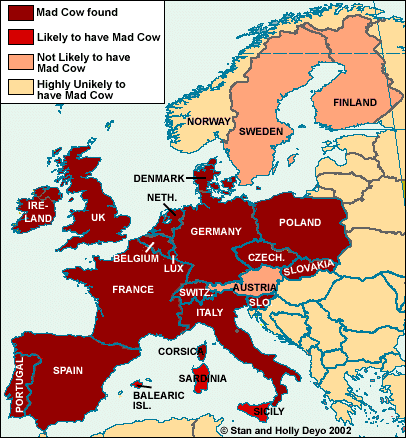
COUNTRIES AT HIGHEST RISK FOR BSE
July 6, 2000 the European Union's Scientific Steering Committee released their Final Opinion GBR (Geographic Bovine Risk) Report. The 60-page document looked at 23 countries and divided them into four levels of risk. Level 1 countries were they least likely to become infected with Mad Cow on through Level 4 which already had established cases of BSE. This graphic was updated Sept. 2002 to include current data beyond what the Steering Committee projected.
OTHER COUNTRIES NOT LIKELY TO GET MAD COW
|
OTHER COUNTRIES HIGHLY UNLIKELY TO GET MAD COW
|
Austria
Canada (only 1 case)
Finland
Sweden
United States
|
Argentina
Australia
Chile
New Zealand
Norway
Paraguay
|
Source: European Union's Scientific Steering Committee Report,
July 6, 200018and http://ourworld.cs.com/_ht_a/j1braakman/BSE1.htm
After looking at the BSE risk map above, some of us - depending on where we live - might start to feel safe and think, "whew! thank goodness it's not here!" Before we get too comfy in a warm blanket of denial, let's remember that:
1) New information on BSE and CJD comes to the forefront nearly
daily.
2) This report focuses on BSE, not the strains found in species other than cows or the five
human forms.... and
3) That was six months ago. . .
This is September 2002. . .
MAD COW and CJD FROM 1988 - SEPTEMBER 20, 2001
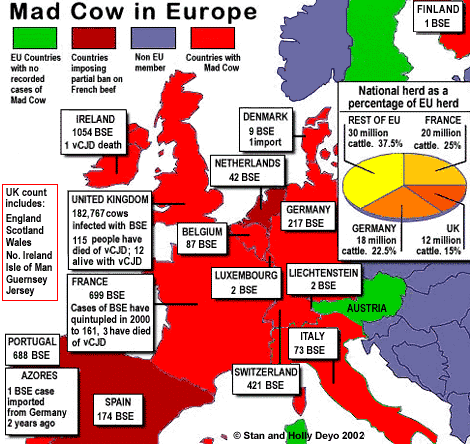
Source: BSE in Europe: http://ourworld.cs.com/_ht_a/j1braakman/BSE.htm
NOTE: These countries also have seen cases of BSE
Poland - 2; Slovakia - 11; Japan - 5; Slovenia - 2; Liechtenstein - 2; Oman - 2; Canada, Israel, the Falkland Islands, and the Azores have each reported one case. Most of these animals were all imported from either Germany of the UK.
Austrian officials reported its first case of BSE on January 14th.
Later, the health ministry spokesman, Gerald Grosz, said test
results couldn't be trusted because there were part of the same
batch showing 64 false positives for Germany last week. New testing
has been ordered. If this analysis shows positive, it will be
the first for a country previously thought fairly unlikely to
get BSE.19 In formation just released today, Austria has been pronounced
Mad Cow-free and is breathing a great sigh of relief. It is one
of the few European Union countries besides Sweden and Finland.19.5
MISERY HATES COMPANY
The BSE mess couldn't have arrived at a worse time while Europe
is trying to cohere into a more solid union and incorporate yet
another 13 member states. During the recent EU conference in Nice,
debates flashed over voting, taxation, defense and a myriad of
other issues bent ruffled feathers into a contorted shape. The
last notoriety Great Britain needed was to be the focal point
of a deadly disease. The ensuing mess has severely shaken member
and nonmember states alike.
France's Agriculture Minister, Jean Glavany, told a Spanish newspaper
El Mundo, "It's our English friends who exported this disease. Morally,
one day they will have to be judged for that, because they granted
themselves the luxury of banning the use of these feeds at home
while allowing them to be exported. From a moral point of view
this is indefensible."20
While Minister Glavany issued this statement, angry meat workers
blocked freeways around Paris, Bordeaux, Toulouse and Lyon, creating
gigantic traffic jams, in protest at the government's handling
of the crisis. The 500 lorries and 1,000 demonstrators threatened
to close all abattoirs (slaughterhouses) this week unless their
demands for compensation for losses are met.
Anger erupted throughout Europe resulting in much finger pointing
and blame assessment. Denial and head-stuck-in-sand maladies are
at the root of problems costing scientists and politicians lost
credibility and people their lives. For a continent whose identity
is closely tied with cuisine, BSE is the ultimate blow to the
ego. It's not just the UK; there's plenty of blame to go around.
Germany had refused to consider they might harbor the deadly disease.
Yet inspectors' evidence found evidence that 75% of food samples
on Bavarian farms contained traces of meat and bonemeal, some
of which had been exported from Britain. Brussels is livid that
for many months Germany blocked EU attempts to ban the use of
beef "risk materials", such as the spine, arguing it was unnecessary.21 Fury over complacency and misinformation led to the resignation
of two German cabinets members. Agriculture minister Karl-Heinz
Funke and health minister, Andrea Fischer both resigned January
9, 2001 each accepting little blame for their country's BSE mess
with Fischer pointing the finger at Funke.
Meanwhile France's President Jacques Chirac and Prime Minister
Lionel Jospin, political rivals, have taken pot shots at each
other over how to respond to the problem. France tried to persuade
other EU countries to support a total ban on MBM feed in November
2000, but found little support. A six month ban, which does not include fishmeal used in pig and poultry
feed, was finally imposed throughout the EU effective January
1, 2001. Disagreements over the ban also arose with Germany saying
the ban is too short. Opposing BSE-free Scandinavian countries
argued bitterly this was "over the top" and "unjustified on scientific
and moral grounds."22
The next issue argued was the eventual decision to test all cattle
for BSE over 30 months intended for human consumption. After a
nine-hour meeting, EU ministers came to a consensus, but the astronomical
costs and losses involved provoked heated debate.
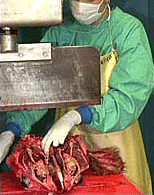 Photo: BSE Testing. There is no on-the-hoof test for the disease, but it may be close. Photo: BSE Testing. There is no on-the-hoof test for the disease, but it may be close.
France further got its national nose out of joint when Ireland
began advertising its beef as "BSE free". Many EU countries blocked
France's beef when their BSE cases quintupled in 2000.
France and Britain have quarreled over beef blockades, Ireland
tried to overturn an Egyptian boycott on its beef and the Czech
Republic banned all beef from EU countries where mad cow disease
has been detected.
Italian farmers blocked trucks at the borders to keep foreign
cows out, but for all the good it did, they still ended up with
BSE.
Spain entered the fray when cattle farmers began blockading slaughterhouses
Monday to try to force the government to compensate them for the
BSE crisis. They want the government to pay for the slaughter
and disposal of infected animals and to fund a campaign to restore
public confidence in beef. Javier Lopez, president of the cattle
breeders' association, Asovac, said: "We're doing this out of
despair. Our aim is not to leave people without meat but that
may end up being the case."23
THE MOO HEARD 'ROUND THE WORLD
There is no way to sugar coat it, despite all the governments'
checks and securities, on December 22, 2000, WHO (World Health
Organization) expressed concern about what it called "exposure worldwide" to mad cow disease and the human form, nvCJD. Dr. Maura Ricketts,
of WHO's animal and food-related public health risks division
stated in a news conference, "Our concern is that there was sufficient
international trade in meat and bone meal and live cattle that
there actually has been exposure worldwide already.
"We know potentially contaminated materials were exported outside
the European Community...We are trying to identify the countries
that we should put our largest effort into. We are concerned some
countries which received materials do not have surveillance systems
to detect the disease in animals or the human population. Countries
of the world need to be developing surveillance systems for these
diseases.''24
Dr. Rickets makes a very important point that tracing possibly
diseased beef and meat products is very difficult saying that
they're often repackaged and relabeled before being re-exported.
It's very easy for the trail to become cold.
While Dr. Rickets declined to specify countries outside Europe
most at risk citing it could provoke consumer panic and economic
upheaval. It's not hard to put the pieces together with these
clues.
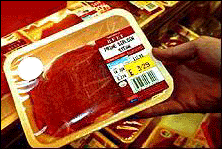 "Meal made from sheep that may have had scrapie has been fed legally to other animals until early 1997, raising the possibility that BSE has infiltrated American beef herds."25 British meats were not banned as an export until 1996."26 Though Dr. Rickets would not name countries at possible risk,
the Campaign for Food Safety, a Minnesota-based national network
funded by individuals and foundations interested in organic food,
said the United States leads the world in "feeding animals to
animals."27 "Meal made from sheep that may have had scrapie has been fed legally to other animals until early 1997, raising the possibility that BSE has infiltrated American beef herds."25 British meats were not banned as an export until 1996."26 Though Dr. Rickets would not name countries at possible risk,
the Campaign for Food Safety, a Minnesota-based national network
funded by individuals and foundations interested in organic food,
said the United States leads the world in "feeding animals to
animals."27
WHERE WERE BRITISH BEEF FEED PRODUCTS EXPORTED?
Britain's bone meal was shipped primarily to France, Germany,
Denmark and Switzerland in Europe. Some was exported to Dubai
and other Mideast and African countries. Of the 3 million tons
of meal produced by the European Union about one sixth, or 500,000
tons was exported mostly to Eastern Europe, Asia and the United
States.28
GREED, SLACKNESS, LOOPHOLES AND UNKNOWNS
Despite all our testing, we still may have problems, some of our
own making and others, and some due to government loopholes.
According to Dr. Ricketts, even though Britain and the US banned cow cannibalism in the early 1990's, some British renderers continued to make and ship contaminated meat and bone meal (MBM) around the world and some European farmers knowingly used these products until November, 2000 because they were cheap.
Public health officials suspect that infected meat was repackaged and resold as having come from countries presumed free of mad cow disease.
British export records show that 20 tons of "meals of meat or
offal" that were "unfit for human consumption" and probably intended
for animals were sent to the United States in 1989. Another 37
tons were exported to the U.S. in 1997 - after the ban of these product - and it has yet to be traced.
 The government allowed into the country many health supplements which contain glandular material from animals whose health status can't be determined. The risk may be very small, but these tissues are more likely to carry the disease. Products must have labels listing ingredients like bovine pituitaries and adrenals, but manufacturers are not required to list the country of origin. So products with these glands may be safe from one country but not another, yet how does one know which it is? The government allowed into the country many health supplements which contain glandular material from animals whose health status can't be determined. The risk may be very small, but these tissues are more likely to carry the disease. Products must have labels listing ingredients like bovine pituitaries and adrenals, but manufacturers are not required to list the country of origin. So products with these glands may be safe from one country but not another, yet how does one know which it is?
It is still perfectly legal to import other beef by-products from
European cattle including milk, blood, fat, gelatin, tallow, bone
mineral extracts, collagen, semen, amniotic fluid and serum albumin.
These ingredients are widely used in American products including
vaccines, candles, food, cosmetics and medicines. Compliance is
voluntary for supplement manufacturers to leave out neural and
glandular material from domestic and foreign sheep flocks infected
with scrapie. The FDA admits not enough testing has been conducted
to say conclusively these items pose no danger.
Until the first of December 2000, many European farmers were still giving feed made from potentially infected cows to chickens and
pigs and then feeding those chickens and pigs back to cows. Is
this any different than cow cannibalism once removed? Now Agriculture
Department officials are worried that European feed manufacturers
will slash prices and try to dump their products on American farmers.
Will people be greedy and buy this potential poison?
As late as Dec. 23, 2000, the FDA instructed American drug manufacturers
to stop using bovine serum from countries where mad cow exists
to make diphtheria-pertussis-tetanus, flu and hepatitis A vaccines.
This does not help people being vaccinated with existing stock
though the FDA maintains it is safe.29
United States health officials are just now closing these many loopholes. In the meantime and dating back
a good decade, to what have we been exposed?
OUR OWN COUNTRY'S GREED
In 1996, the U.S. livestock industry voluntarily banned sheep
and certain other animal parts from U.S. animal feed. The next
year, the FDA's formal regulations stated feed manufacturers,
renderers and farmers/producers were to abide by four things:
 1. A ban against feeding any proteins from cows, sheep, goats, deer or elk to other ruminants
(cud-chewers) like cows, sheep or goats. 1. A ban against feeding any proteins from cows, sheep, goats, deer or elk to other ruminants
(cud-chewers) like cows, sheep or goats.
2. Poultry or pigs can still eat those proteins, but feed must
be labeled "do not feed to cows or other ruminants".
3. Companies must have systems in place to prevent accidentally
mixing up the feeds.
4. Feed manufacturers must keep records of where their products
originated and where they were sold.
How tough is this to get? Pretty straightforward, nobody's speaking
Latin here.
You'd think that fear for their own mortality or at least that of their loved ones would keep feed manufacturers on the straight and narrow. Oh no. Greed or laziness or both set in. FDA inspectors found literally hundreds of animal feed producers violating these regulations. In a report issued January 10, 2001, the FDA released the following:
Of 180 renderers -- companies which turn that vat of slaughtered
animal parts into meat and bone meal (MBM) "protein concentrates":
- 16% didn't have warning labels
- 28% didn't have systems to prevent feed mix-ups
Of 347 FDA-licensed feed mills that handle the risky MBM feed
- 20% didn't have warning labels
- 9% didn't have systems to prevent feed mix-ups
Between 6,000 and 8,000 feed mills are so small they aren't required
to have FDA licenses, but they are required to abide by the same federal regulations. Of 1,593 small feed
producers
- 40% didn't have warning labels
- 25% didn't have systems to prevent feed mix-ups
Of all companies inspected, big or small, less than 10% flunked
record-keeping for the regulations.30
Maybe these companies would like a little BSE atop their burgers!
Sometimes people's greed, slackness and lack of ethics are simply
quite unbelievable.
While the FDA is quick to assure that violations don't automatically
equal tainted food, the FDA has issued warning letters to these
companies and recalled some of their feed. The agency promises
should companies continue ignoring safe manufacturing, they'll
face seizures, shutdowns, and prosecution.
In the last of this series, we'll continue to examine our risk
for BSE through what measures the governments of Australia, Canada
and the US have in place. We'll take a close look at Chronic Wasting
Disease in deer and elk, plus whether or not we might get CJD
- the human form of this terrible disease through blood, milk
and milk products and what you can do in your home to keep it
BSE-free.
Stan and I want to thank Vicki Nelson, Steve Robinson and Judith Meyer for their contributions this week! We also need to give special thanks to a woman who wishes to keep her name confidential for her considerable information on BSE conditions in Europe. Her brother is a farmer in Italy and has only fed his livestock grains. She spoke with him last night and he shared that at that moment, over 20 tractors were blocking the exit of trucks from a farm near Brescia, Italy where a BSE cow was found. By law now, when a diseased cow is found, the whole herd must go and these farmers were protesting the pending cattle incinerations. Meanwhile, in Germany, farmers protested the proposed incineration of 400,000 head of cattle.
She wrote, "Government agencies claim that only cattle under 24
months of age are butchered for public use and that they are safe
from BSE. They also claim that poultry, pigs and fish grown in
fish farms are safe. However the public does not believe this."
This woman shared another interesting piece of information you
won't read in the papers or see on the news. It seems in the last
two weeks one death and one other person near death were both
reported to have vCJD. Within a few days, retractions were made.
She said the same thing had happened last summer. We may never
know the truth of how severe the CJD death toll really is. Next
week, we'll share some more of her inside information on the food
industry. Thanks again everyone!
With affection,
Holly and Stan
Seismo and Taco
Taco: "Hey Seis, what're ya thinking?"
Seismo: (rolls over lazily) "Nothin' special, just about that big earthquake in the salad bar, Ensalada, and about how I'm glad that little dog they rescued wasn't me!"
Taco: "What in the world are you talking about?"
Seismo: I heard Mom and Dad talking about that quake last night - Ensalada Bar - didn't you hear? And if you must know, "ensalada" means "salad" in Spanish. HA! So there! Betcha didn't know I knew that, didja!
Taco: "Seismo, you dumb dog, that was 'El Salvador', not Salad Bar! Don't you ever think about anything but your stomach? I swear you forget to pack your brain in the morning!"
Seismo: "Ugh! Don't mention brain, makes me think of BSE again.
Taco: "Yeah, and you'd still be trying to tell me that BSE stands for Bones, Steak and Everything!"
Seismo: "Gee Tac, couldn't you just forget that? Your memory must be a mile long except when The Parents tell you not to dig in the backyard!"
Taco: "Me! Me? Tell me not to d . . . " (Taco trotted after Seis, still chewing his tail.)
Stan and Holly Deyo
P.O. Box 7711, Pueblo West, CO 81007
http://millennium-ark.net/
© Text and Graphics, 2001 Stan and Holly Deyo, except where otherwise
credited
Sources:
1New Rules To Cut BSE Risk; January 1, 2001;
http://news.bbc.co.uk/hi/english/uk/newsid_1095000/1095954.stm
2"National Transmissible Spongiform Encephalopathies Surveillence
Program";
From Animal Health Surveillance Quarterly; Volume 2, Number 4
3Animal Health in Australia;
4Scientist Says Mad Cow Tests Do Not Guarantee Infection Status;
January 11, 2001; http://dailynews.yahoo.com/h/nm/20010111/ sc/madcow_tests_dc_1.html
4.5 CSU Rushing To Create Live Test for CWD; August 7, 2002; http://www.denverpost.com/Stories/0,1413,36%257E11799%257E778502,00.html
5Cattle Mutilations; http://www.isur.com/archive/cattle/mutilation.html
6NOVA #2505: The Brain Eater; February 10, 1998; http://www.pbs.org/wgbh/nova/transcripts/2505braineater.html
7R.F. Marsh and others, "Epidemiological and Experimental Studies
On A New Incident of Transmissible Mink Encephalopathy;" Journal
of General Virology; Vol. 72, Part 3 (March 1991), pages 589-594.
8Official USDA Estimate Of BSE In Downer Cows; May 18, 1999;
http://www.mad-cow.org/usda_downers.html#aaa
9Official USDA Estimate Of BSE In Downer Cows; May 18, 1999;
http://www.mad-cow.org/usda_downers.html#aaa
10The Public Health Implications of Mad Cow Disease by Michael
Greger; July 27, 1996; http://www.ivu.org/congress/wvc96/madcow.html
11The Public Health Implications of Mad Cow Disease by Michael
Greger; http://www.ivu.org/congress/wvc96/madcow.html
12The Public Health Implications of Mad Cow Disease by Michael
Greger; http://www.ivu.org/congress/wvc96/madcow.html
13Interview with Michael Greger; May 6, 1996; referring to British
Journal of Psychiatry (1991) 158:457-70; http://www.mad-cow.org/~tom/greg.html
14How It Went So Horribly Wrong; Andy Coghlan; http://www.keysites.com/nsplus/insight/bse/howitwent.html
15 Finding Of No Significant Impact and Environmental Assessment
For 21 Cfr 589.2000 Prohibition Of Protein Derived From Ruminant
And Mink Tissues In Ruminant Feeds; center For Veterinary Medicine
Food And Drug Administration; November 1996; page 78
16How It Went So Horribly Wrong; Andy Coghlan; http://www.keysites.com/nsplus/insight/bse/howitwent.html
17Stringent Steps Taken by U.S. on Cow Illness; January 14, 2001;
http://www.nytimes.com/2001/01/14/health/14COW.html?pagewanted=all
18Final Opinion of the Scientific Steering Committee on the Geographical
Risk of Bovine Spongiform Encephalopathy (GBR) Adopted on July
6, 2000; F. Joachim Kreysa; http://europa.eu.int/comm/food/fs/sc/ssc/out113_en.pdf;
July 6, 2000
19Austria, Italy Hit By Mad Cow Fear; January 14, 2001;
http://www.washingtonpost.com/wp-srv/aponline/20010114/aponline152850_000.htm
19.5Mad Cow Frenzy Moves To Italy; Philip Pullella; January 18,
2001; http://www.mad-cow.org/UKCJD/CJD_news33.html
20 France Blames Britain For Its BSE; January 9, 2001; http://www.telegraph.co.uk:80/et?ac=003662531325865&rtmo=
gjVGZgYu&atmo=tttttttd&pg=/et/01/1/9/wbse09.html
21Warnings on BSE Were Ignored By Berlin; December 30, 2000; http://www.telegraph.co.uk:80/et?ac=003662531325865&rtmo=0xsbsKeq&atmo
=rrrrrrvs&pg=/et/00/12/30/wbse30.html
22 France Reveals New Mad Cow Tally; December 5, 2000;
http://news.bbc.co.uk/hi/english/world/europe/newsid_1055000/1055558.stm
23 Letter From Brussels Fuels Panic Over BSE; January 16, 2000;
http://www.telegraph.co.uk:80/et?ac=003662531325865&rtmo
=aC4WquKJ&atmo=tttttttd&pg=/et/01/1/16/wbse16.html
24FDA Prohibits Mammalian Protein In Sheep And Cattle Feed; June
3, 1997; http://vm.cfsan.fda.gov/~lrd/tpprotei.html
25Mad Cow May Have Spread Worldwide - World Health Organization;
December 22, 2000; http://dailynews.yahoo.com/h/nm/20001222/sc/madcow_who_dc_1.html
26Worldwide Meat Trade Might Have Spread Disease, WHO Warns; Elizabeth
OlsonInternational Herald Tribune; December 23, 2000
27Ibid
28Beef Exports Raise Fears of Exposure To Mad Cow Elizabeth Olson
International Herald Tribune;
Saturday, December 23, 2000; http://www.iht.com/articles/5261.htm
29Worldwide Meat Trade Might Have Spread Disease, WHO Warns; Elizabeth
OlsonInternational Herald Tribune; December 23, 2000
30Makers Of Us Feed Fail To Heed Rules On Mad Cow Disease; January
11, 2001; NY Times; http://www.nytimes.com/2001/01/14/health/14COW.html
31El Salvador Buries Quake Victims; January 15, 2000;
http://www.usatoday.com/hphoto.htm
|