 |

.
PAGE ONE
The Cow Connection
Testing 1 - 2 - 3, Testing
BSE Surveillance in Canada
BSE Surveillance in the US
BSE Testing vs Herd Count
BSE Surveillance in Australia
Signs of Trouble
No Perfect Test
PAGE TWO
CJD and Alzheimer's -
Twins?
Mystery Mutilations - An Answer?
Downers and Stetsonville Mink
Mad Cows, Englishmen and the BSE Inquiry
Scientists Also at Fault
PAGE THREE
Countries at Highest Risk
This is Now. . .
Misery Hates Company
The Moo Heard Round The World
Where was Brit Beef Shipped?
Greed, Slackness, Loopholes
Our Own Country's Greed
One possibility is an instrument like this one from UltraCision
called The Harmonic Scalpel. Ultrasonic welding or cutting of
thin tissues or substances is not new technology; it dates back
to the 1950s. A number of years ago, Dr. Graham Paget, a personal
friend of ours in Perth, gave Stan a brochure and video demonstrating
its abilities. The Harmonic Scalpel vibrates 55,000 times per second neatly slicing tissue like the proverbial hot knife through butter
and simultaneously cauterizes the wound; e.g. there is no bleeding
or fluid leakage. Continue
CJD and ALZHEIMER'S - FRATERNAL TWINS?
Officially CJD occurs once in every million people annually, world wide. This would mean about 6,200 new cases across the globe each year IF this were all the cases of this disease. Saying "if" is not meant to diminish
the agony of thousands of victims and their loved ones, but there
is concern that some previously diagnosed Alzheimer's cases are
really CJD.
There are striking similarities in these two diseases. Both target
mainly older people and the primary symptoms of each are dementia,
memory loss, depression and death. Some Alzheimer's victims show
the same spongy lesions in the brain. Dr. Prusiner who won a Nobel
Prize for his work in prion diseases, speculates eventually Alzheimer's
may actually be shown to be a TSE. These similarities have caused
diagnosis problems possibly severely underrating the occurrence
of CJD. Though similar in appearance to Alzheimer's, they have
a different protein.
There are varying estimates among doctors and scientists about
the real occurrence of CJD. At Yale, six out of 46 patients clinically diagnosed with Alzheimer's were proven to be CJD cases at autopsy. In another post-mortem study, three out of 12 Alzheimer patients actually died from a TSE.5
Carleton Gajdusek, recipient of a Nobel Prize for his work with
prion diseases, estimates that 1% of all people showing up in
Alzheimer clinics actually have CJD.6
A 1989 University of Pennsylvania study showed that 5% of patients
diagnosed with dementia were actually dying from CJD.7
A 1991 informal survey of neuropathologists published in the British
Journal of Psychiatry put a theoretical range of 2-12% for all
dementias actually being CJD.8
According to The Alzheimer's Association, there are approximately
4 million Americans suffering with this disease. Taking the absolute
lowest probability of 2% misdiagnosed Alzheimer's cases, it would
boost the CJD count to 80,000 just in the States.
MYSTERY MUTILATIONS
Time for a little lateral thinking. . . For decades, the mystery
of cattle mutilations has haunted ranchers, farmers, investigators
and people intrigued by the phenomena. At least 10,000 cases involving
cattle had occurred around the world by 1979. Mutilated animals
other than cattle and horses - the two main targets - have also
been seen.
The top four reasons explaining these weird events have been attributed to:
 1. satanic cults and ritual sacrifices
2. black ops chemical weapons testing
3. mass hysteria blowing simple cow deaths out of proportion
4. extraterrestrial experiments
Certainly satanic cults can rightfully claim a number of these
incidences in Alberta, Idaho, Montana, and Iowa.
Explanation #2 also has validity because during waves of cattle mutilations, blackunmarked helicopters with tinted windows and powerful searchlights have been witnessed in the area. Since most often there are no tracks or footprints, it leads one to think the cattle had been lassoed, hoisted mechanically into the chopper, "operated on" and then dropped back to the ground. We certainly have had chemical weapons for more than half a century. It is reasonable to say that since many of our vaccines are bovine-based that our chemistry is compatible with cows in terms of how a biological agent might affect us.
The third explanation lacks credibility due to the sheer number
of events reported. To chalk up this many mutilations worldwide
to mass hysteria doesn't wash.
The fourth explanation, weird as it may sound, may also have validity.
UFOs have often been seen in the vicinity of cattle mutilations.
Witnesses report that the animals are deathly afraid of UFOs,
frequently stampeding and bellowing when in their presence. Two
separate alien abductees reported, under hypnosis, seeing cattle
taken into the alien craft and mutilated.9
ANOTHER ANSWER
A fifth possible explanation exists - early BSE testing. This
is not to indicate that every mutilated animal is a product of
BSE analysis, but it may well account for some.
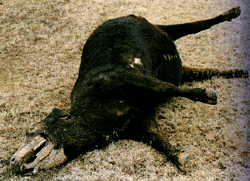
All body parts removed from mutilated cattle have to do with either
eating, excreting or reproducing. Bovine jaws are stripped to
the bone as seen in the photo above, reproductive organs, entire
tongues and digestive tracks are removed, and rectums and eye
sockets are "cored" out. If one is tracking disease, these are
the areas to check. Additionally in some cases, all blood has
been drained from the animals - another prime disease carrier.
More graphic pictures of cattle mutilations show perfectly sealed,
surgeon-like precision cuts where the organs are taken. Some people
have suggested cattle mutilations are the product of wild animals,
but they would leave jagged edges and tears in the tissue. So
what could be responsible?
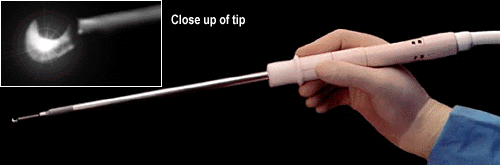
This instrument evolved from plastics welding and cutting technologies
developed by the Branson Ultrasonics Corporation in the 1950s.
It had numerous applications and performed equally well on plastic,
metal and human tissue. If the truth were made public, the human
tissue effects were probably the results of accidental damage
to factory workers in companies like Branson. Stan's father used
high-powered ultrasonics in his research laboratory in Dallas
as far back as 1957. His staff suffered several accidental wounds
from working with improperly shielded ultrasonic "horns" (as the
vibrating tools were commonly called in the industry).
When another big uproar surfaced a few years back about the origin
or cattle mutilations and what could possibly be responsible for
the precision cuts, Stan contacted one of the best known investigators
in this field to shed light on the issue. The person in question
didn't want to hear it preferring to turn a blind eye to this
answer, and instead, continued to hype the mystery. This investigator
has videos and books published on the topic so having a rational,
plausible answer may have taken away from the mystique surrounding
the mutilations.
One excellent paper on the possibility that the cattle mutilations
are connected with BSE testing was written by Ted Olliphant III.
His paper 'UFO' Mutilations, Mad Cow Disease, and the U.S. Government can be found on several web sites including a copy archived on Jeff Rense's wbsite.
DOWNERS AND THE STETSONVILLE MINK
Another chapter in the TSE story is "downer" cows and the Stetsonville
mink. Downer cows are animals, who, for a myriad of reasons not
necessarily related to BSE, are unable to stand.
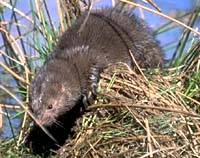
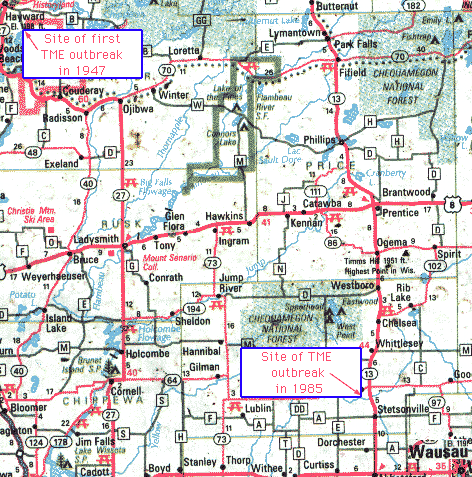
In 1947, and in 1985 in Stetsonville, Wisconsin, mink farm herds
came down with a rare form of spongiform encephalopathy. Almost
overnight, the mink showed classic symptoms - loss of coordination
and weight, and listlessness. Within weeks, they died. Literally
scores of mink lost their lives. Since they were being raised
for fur coats, the TSE just hastened their exit.
University of Wisconsin's veterinarian, Richard Marsh, was called
in to figure out what had caused the epidemic. Marsh thought something
in the feed might be spreading the disease so he began his investigation
there.
Mink are voracious meateaters, but their diet had not included
sheep so Scrapie was ruled out. They were fed this deadly combination: 95% ground up carcasses of downer
cattle and 5% horse meat. (TSEs have not been found in horses
yet.) The connection led Dr. Marsh to conclude that "a low-level
native strain of BSE exists in the United States, but was going
undetected."10 (A nearly-undetectable disease is referred to as a "sub-clinical".)
This raises an unsettling question, do countries and regions other
than the UK harbor their own strains of BSE?
Dr. Marsh performed revealing tests on the Stetsonville mink and
cows. Marsh injected TME (transmissible encephalopathy in mink)
infected brains into two calves. Within 19 months, both calves
had BSE, but the symptoms weren't like Britain's mad cows. The
Stetsonville cows showed symptoms of downer cows becoming lethargic
and unable to stand. Brains from these cows were then injected
into mink. They came down with TSE confirming the kind of disease
that had killed the cows. Marsh and his colleagues concluded,
"These results suggest the presence of a previously unrecognized
scrapie-like infection in cattle in the United States."11
Another laboratory scientist in the mid-1990s, Dr. Mark M. Robinson,
with ARS, USDA, Animal Disease Research Unit also investigated
the Stetsonville mink deaths. Robinson had published several papers
on experimental transmission to cattle and sheep. His study concluded,
like Marsh and other scientists, that a very low level of a non-UK
strain of BSE in Wisconsin dairy cattle killed the mink in 1985.
Robinson wrote, "at most, 1 out of every 27,500 nonambulatory
adult cattle [downers] was affected with the transmissible encephalopathy,
and 1 out of 975,000 of all adult cattle was affected with the
transmissible encephalopathy per year in Wisconsin."12
In a second paper from Dr. Robinson Bovine Spongiform Encephalopathy in the United States, published by the USDA APHIS vs CEAH Ft. Collins, pages 21-25
are more alarming. The paper states, "the survey suggested that
almost 5,000 nonambulatory (downer) cows suspected of having a
transmissible spongiform encephalopathy (TSE) could have been
fed to mink in the surveyed States in 1982."13
Now take another look at the "BSE Surveillance NVSL Bovine Brain
Submissions" graph on the first page. There is a HUGE jump in
downers in the US from 1999 to 2000 - almost 200% more. Somebody
must have gotten spooked because brain submissions also shot way
up - almost 2-1/2 times over the preceding year.
Despite these findings, scientists still state the US is free
of BSE. Maybe we are free of Britain's type of BSE, but are our
cows and other countries' bovines harboring their own strain of
BSE? If so, our government is testing for the wrong kind of BSE.
MAD COWS, ENGLISHMEN AND THE BSE OFFICIAL INQUIRY
Over 180,000 cows have been diagnosed in Europe with BSE and 4.7
million animals over 30 months old have been slaughtered to stop
the spread. Britain acted way too slow, covered up information
and lied to its citizens through a decade of denial, misinterpreted
and ignored early warning signs, and from the get-go, operated
under the assumption that TSEs could not jump species. The sum
total of ignorance and error escalated into tragedy. It will be
years before the full fallout is known or we see how many lives
CJD will claim, but there are invaluable lessons to be learned
by the rest of the world. The question is, are we paying attention?
 In a 4,000 page report that took two and a half years to complete
and cost an unprecedented £27 million, the BSE Inquiry damned
a number of events, scientists and Britain's government for the
deadly epidemic. You can view the BSE inquiry in full or read the highlights below.
In a 4,000 page report that took two and a half years to complete
and cost an unprecedented £27 million, the BSE Inquiry damned
a number of events, scientists and Britain's government for the
deadly epidemic. You can view the BSE inquiry in full or read the highlights below.
From a single cow traced to 1970, arose incredible disaster. Because
Scrapie had not been a problem for humans, it was wrongly assumed
BSE posed no danger either. The practice of bovine cannibalism
through rendering set in motion an unstoppable, unbelievable chain
of events. "This now seems surprising, because scientists had
known for 10 years that once a spongiform encephalopathy, such
as scrapie, jumped the species barrier it could become more pathogenic to other animals."14
Additionally, there's no question they knew their cattle herds
were severely infected early on. In a United States FDA report it states: "In the United
Kingdom, 47.5% of the dairy herds and 10.9% of the beef suckler
herds are infected (MAFF, 1993). The lower incidence of BSE in
the beef herds vs. dairy herds in the United Kingdom is not attributable
to any difference in breed predisposition, but to different feeding
practices in dairy and beef herds. In dairy herds in the United
Kingdom, the feeding of concentrate rations likely to contain
meat and bone meal is common during the first six months of life
(Wilesmith et al., 1992)."15

When asked about the safety of beef, government officials repeated
the findings by a 1989 British advisory committee on the disease
that BSE was unlikely to cause problems for humans. According
to the BSE Inquiry, they quietly buried the warning that "if the
assessment was incorrect, the implications would be extremely
serious". As a result of these reassurances issued as late as
March 20, 1996, infected beef still entered the food chain.
SCIENTISTS ALSO AT FAULT
They ignored decade-old evidence that BSE could jump species.
Scientists also overlooked that only a "peppercorn" or 1/2 gram
(that's 1/60 of an ounce) of BSE-contaminated material could infect
a cow. "For five years, this ignorance led to slaughterhouses
routinely breaking the ban on BSE-contaminated cattle material,
known as specified bovine offal (SBO), entering the human and
animal food chains. This perpetuated BSE on farms."16
BSE contaminants continued to enter the British human food chain until 1996 from "mechanically recovered meat", edible material scraped from the spines of cows. This area is very close to the spinal column - one of the highest infection-harboring parts ofthe body for Mad Cow disease. Spinal cords which have been a regular ingredient in German sausages led to a huge recall of exported German sausages three weeks ago.
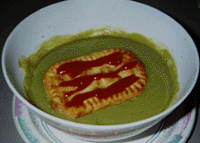 Photo: This little dining delight is called a Floater or a meat pie floating in a bowl of pea soup. The local saying is "Pour that down your neck mate!" Mmm good. Mmm good. That's what Floater pies are: mmm, mmm good.
Other techniques of mechanically recovering meat (MRM) use highly
pressurized water to remove minute scraps of meat after de-boning.
This method breaks down the meat so it flows off the bone as puree.
MRM is used in meat products such as meat pies (see the "floater"
in the photo) and chicken nuggets, and as a binding agent. (Ever
since junior high school, smart kids refused to eat meat pies
at lunch wondering what in the world was the "mystery meat". To
this day, a meat pie or pot pie has yet to pass my lips, so guess
I'll never make it as a Brit or an Ozzie. However, hotdogs are
another story. . . They'll getcha one way or another!)
Once scientists got their act together, the government dropped
the ball. It failed to inform the public and non-government scientists
about vital BSE information. It should have, but didn't, coordinate
research about the emergence and spread of the disease. If people
aren't told how it spreads, they're being handed a death sentence.
Britain's Ministry of Agriculture, Fisheries and Food (MAFF) withheld
scientific information for six months, further encouraging the
spread of BSE through ignorance. They also withheld knowledge
of how to spot new cases and trace the epidemic. More delays followed
because the government had cut the budget for agriculture and
animal health by 20% which covered BSE research.
Last, MAFF failed to release data and research material to independent
researchers, especially those outside Britain, who may have been
able to help.
This unbelievable chain of screw-ups has led to this - more than
180,000 cows infected with BSE and 89 human deaths from vCJD -
so far. Additionally WHO released last month concerns that BSE may have been exported globally. "The United Nations estimated that at the height of the mad
cow epidemic in Britain at least 500,000 tons of untrackable bovine
byproducts were exported from Britain to Western Europe and other
nations around the world, including the United
© Text and Graphics, 2001 Stan and Holly Deyo, except where otherwise
credited